


Essay focus: The extent to which expansionary fiscal policy can close a deflationary gap.
- Sep 5, 2020
- 4 min read
Updated: Sep 6, 2020
The essay below is an IB Economics 15 mark question response, and achieved a level 7. There is also a guiding structure given for each part.

Definitions
Fiscal policy is the manipulation of government spending and taxation to influence Aggregate demand, whilst Long term Economic Growth refers to the increase in the productive capacity of an economy in the long run. The extent to which Fiscal policy can be used to achieve long term economic growth will be discussed below.
Point 1: In support of fiscal policy
Since fiscal policy involves the usage of government spending, the government could use expansionary fiscal policy, which refers to an increase in government spending and a reduction in taxes to achieve long term economic growth.
Explanation + Diagram
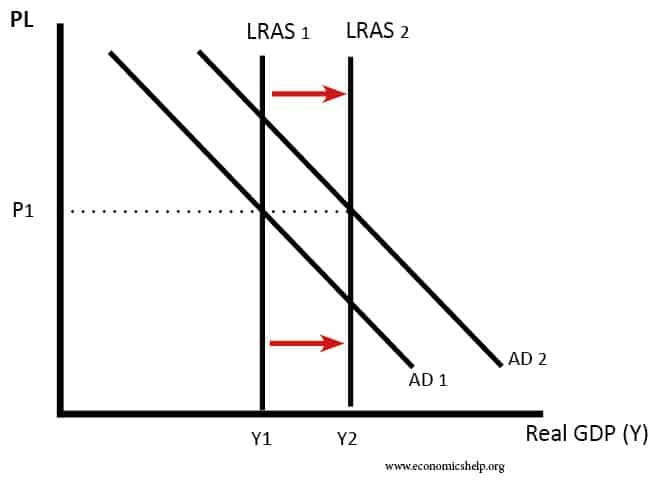
When there is an increase in government spending on factors of production, such as research and development, there will be an increase in the productivity of physical capital. Since physical capital is a factor of production, an increase in productivity of physical capital will increase the quality of factors of production, which may lead to a rightward shift in the Long Run Aggregate Supply curve (LRAS) from LRAS to LRAS1. Since government spending is a component of Aggregate demand, expansionary fiscal policy could shift Aggregate demand from AD to AD1, which also increases output from Y to Y1, thus leading to Long term economic growth.
Example
An example of this is research and development of Artificial Intelligence in China which involved a lot of government spending which helped increase long term economic growth for China, placing their GDP at around 13 trillion USD in 2019.
Evaluation
However, the issue with expansionary fiscal policy is that if the government is in a budget deficit, where government expenditure is larger than government revenue, then this may result in the crowding out effect, where the government borrows money from the bank to fund a particular policy which in this case, is expansionary fiscal policy. Therefore, this may lead to an increase in interests rates which may be undesirable as it may result in a decrease in consumption and expenditure, thus resulting in a decrease in Aggregate demand.
Point two: The consideration of Monetary policy (Against expansionary fiscal policy)
Another policy that the government may consider is monetary policy, which is a demand side policy, referring to the manipulation of interest rates to influence Aggregate demand and the government may use monetary policy to improve long term economic growth as it does not result in the crowding out effect.
At the same time, another advantage of monetary policy is that since there are more frequent alters to monetary policy, it may help stabilize the economy instead of fiscal policy where there may be risk of hyperinflation.
Explanation
When there is monetary policy implemented, there will be an increase in stability of the market as the central bank can fine tune the economy by frequently changing the interest rate. Therefore, firms may be more able to forecast the future inflation rates in the economy which may increase the willingness of firms to expand their businesses and employ more factors of production, such as capital through an increase in investments, which leads to an increase in the quality of factors of production due to higher productivity of physical capital, thus leading to long term economic growth.
Evaluation:
However, when the economy is undergoing a recession, which is where there are two consecutive quarters of negative GDP growth, monetary policy may not be effective as firms may be unwilling to increase production due to low business confidence for the future, which does not increase long term economic growth.
Example:
For instance, during the coronavirus outbreak, the federal bank lowered interest rates to around 0 to 0.5% and due to low business confidence, producers were unwilling to increase supply and expand their businesses in the United States, which is a prime example of the limitations of monetary policy in assisting long term economic growth.
Point Three : The consideration of Supply-side policy (Against expansionary fiscal policy)
Another policy that the government can consider is supply side policies which are policies that help increase aggregate supply of the economy, such as the removal of minimum wages
Explanation:
By taking the market based supply side policy of removing minimum wages as an example, there will be a decrease in the cost of production for firms. Driven by self-interest profit maximization incentives, firms may be willing to produce more goods and services in the market as it is more profitable to produce which increases the quantity of factors of production employed in the production process, thus increasing long term economic growth.
Evaluation
However, the removal of minimum wages may lead to an increase in protests as workers may be dissatisfied with lower wages received which decreases social welfare in the economy due to larger amounts of social disruption, through protests for higher wages.
Example: (Please read the writer's comments for this which can be seen right below the ending of the essay)
For instance, in 1970's, Margaret Thatcher removed trade union power which lead to an increase in protests from 1979 to 1987, due to an increase demand for higher wages.
Conclusion:
To conclude with, the usage of fiscal policy may not necessarily be the most effective way in encouraging long term economic growth, for that there are other policies such as monetary policy and supply side policies. Although, the effectiveness of fiscal policy depends on the type of fiscal policy implemented as a decrease in taxation for instance would not necessarily lead to the crowding out effect and can encourage producers to produce leading to long term economic growth.
Grade: Level 7
Writer's Comments:
Strengths
The overall structure is very good and followable
The comparisons of different policies gives room for more critical analysis.
The chains of reasoning are logical and coherent.
The usage of evaluation for each particular policy makes the essay more insightful
Diagrammatic analysis is used, but NOT THE SOLE FOCUS*
* (Many students tend to place emphasis on diagrammatic analysis, which makes the essay less evaluative due to less content focused on evaluation and discussion)
Weaknesses:
The example of Margaret Thatcher removing trade union power does not necessarily link back towards the removal of minimum wages, which was the supply side example used for point 3.
Inquiries
If you have any inquiries and suggestions for this particular essay, feel free to send me an email which is attached in the contact page. If you are interested about other aspects of business or economics, feel free to check out my other posts!

Comments